Plans for a new employment support service were set out in 2024’s Get Britain Working White Paper. The report describes a need for a new way of helping jobseekers, using products that keep pace with a changing labour market.
Tasked with “nothing less than radical reform”, we began work to understand the problem space.
Gathering jobseeker insights
We first carried out discovery research with jobseekers and analysed more than 120 research and data reports. From this, we identified high-level user needs and explored different ways to segment our users.
Our research showed that jobseeking journeys are rarely linear. Participants felt overwhelmed and in need of an empathetic employment support service.
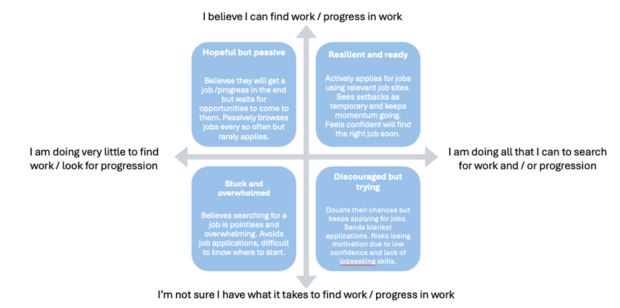
This led us to test a mindset-led approach to user segmentation.
We mapped participants' beliefs about work against what they do to find work. This created four groups of jobseekers, ranging from 'resilient and ready' to 'stuck and overwhelmed'.
With these insights, we started work on the homepage.
The homepage serves as a starting point to help users get to the right tool or support for them. We explored two design options.
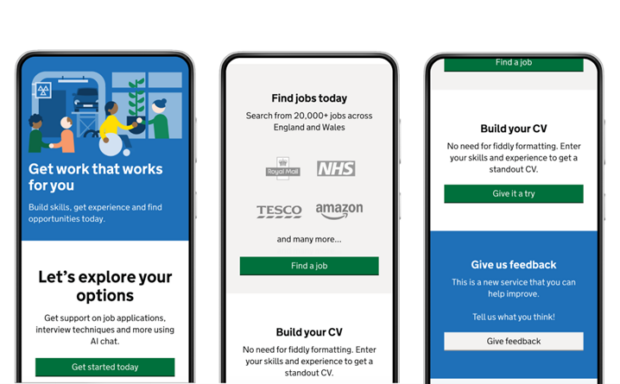
Product-led
This is a product-first approach rather than framing products around the mindsets. It leads with products first and addresses how jobseekers might benefit.
Mindset-led
As suggested by the title, this approach places mindsets front and centre. The aim was to empathise with jobseekers, using four mindset statements for each group.
Each statement sends users to the most helpful products relevant to them.
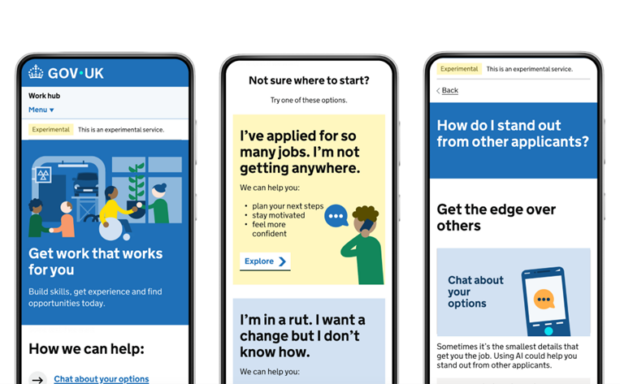
Users navigated through the mindset-led design with ease and clarity. Clear calls to action and evocative mindset statements created a positive user experience.
Our mindset approach performed much better than the product-led designs. Which is a real win for user-centred design.
Collaborating with the Government Digital Service
We wanted to shift perceptions regarding government-provided employment support, demonstrating that it is a service for everyone, not just for those on lower-income jobs.
We collaborated with the GOV.UK team at GDS and experimented with their updated branding and illustrations. This enabled us to enhance our visual experience while maintaining familiar government design standards.
Users responded positively to the jobs and careers homepage, describing it as reflective of a modern and trusted government service.
In user research and via the mindsets, participants quickly recognised themselves, and people they knew. The statement, ‘I’ve applied for so many jobs and I’m not getting anywhere,’ resonated strongly.
Our homepage and first iteration of tools are now live.
Adapting the language
Developing the homepage felt like exploring a brave new world for content design in government.
The language we've used is a slight departure from what you might see across the DWP. People do not need to use this service, so there’s definitely an element of ‘writing to persuade’.
Using calls to action in this way, while still resembling well-established government standards, was a real challenge. As ever, plain language and absolute clarity were important factors in the process.
Our headline 'Get work that works for you' had tested positively from the beginning. We put it in front of users during our earliest round of research. It's an emblem for what we think is a modern and progressive service, and takes into account the diverse circumstances jobseekers can have.
We will continue iterating the homepage. At the time of writing, we have further research already planned. All in a day's work for a trio of UCD practitioners.
Leave a comment